Accelerated TMS has no single success rate. Pooled research suggests about 42.4% of patients respond and 28.4% reach remission after accelerated treatment for depression.
A review of 23 studies with 882 participants found wide variation between protocols. This article explains what those figures mean and how TMS of Tennessee approaches treatment expectations.
Key Takeaways
- Broad research reports about 42.4% response and 28.4% remission across accelerated TMS studies.
- Specialized protocols can report much higher rates, but small samples and individualized targeting make those figures unsuitable as general expectations.
- TMS of Tennessee helps eligible patients understand treatment options. Clinical suitability and expected outcomes should be assessed individually.
What Does “Success” Mean in Accelerated TMS?
Clinical success in TMS research means either response or remission. Each one measures a different level of depression improvement.
Response means a validated depression score drops by at least 50% from baseline. A patient can respond substantially and still have meaningful symptoms. Remission means symptoms fall below a set threshold on a validated scale. Researchers commonly use the Montgomery-Åsberg Depression Rating Scale (MADRS), Hamilton Depression Rating Scale (HDRS-17), or PHQ-9 to measure outcomes.
This distinction matters. A reported success rate can look higher or lower depending on which outcome was selected. A clinic reporting remission is describing a different result than a study reporting response.
A pooled analysis of 882 participants reported a 42.4% response rate and 28.4% remission rate across high-frequency accelerated TMS and accelerated theta-burst stimulation protocols.
Three outcomes worth tracking:
- Response: depression symptoms decrease substantially
- Remission: symptoms reach a predefined low-symptom range
- Durability: improvement remains at later follow-up
What Is the Average Success Rate of Accelerated TMS?
The broadest published estimate is about 4 in 10 patients achieving response and 3 in 10 achieving remission. Individual accelerated protocols can produce very different results.
Across 23 accelerated TMS studies, pooled data showed a 42.4% response rate and 28.4% remission rate. Individual studies varied widely. Some small samples had no responders. Highly selected research groups reported rates above 90%.
That range exists because accelerated TMS is not one standard procedure. Stanford University, UCLA, and other research centers have studied different schedules, stimulation patterns, targets, pulse doses, and patient groups.
Most accelerated TMS trials enroll patients who have already failed multiple antidepressants. Their results should not be compared directly with patients who receive TMS earlier in treatment.
Breakdown by protocol type:
- High-frequency accelerated TMS: 43.5% response, 32.3% remission
- Accelerated theta-burst stimulation: 43.5% response, 27.3% remission
These figures describe research populations. Age, diagnosis, depression severity, prior treatment response, stimulation target, and follow-up timing all affect results. A fair comparison requires matching outcome definitions, patient group, protocol, and follow-up period.
Why Do Accelerated TMS Success Rates Vary So Much?
Accelerated TMS includes many different treatment schedules. Changes in daily sessions, stimulation dose, targeting method, and follow-up timing can shift reported outcomes significantly.
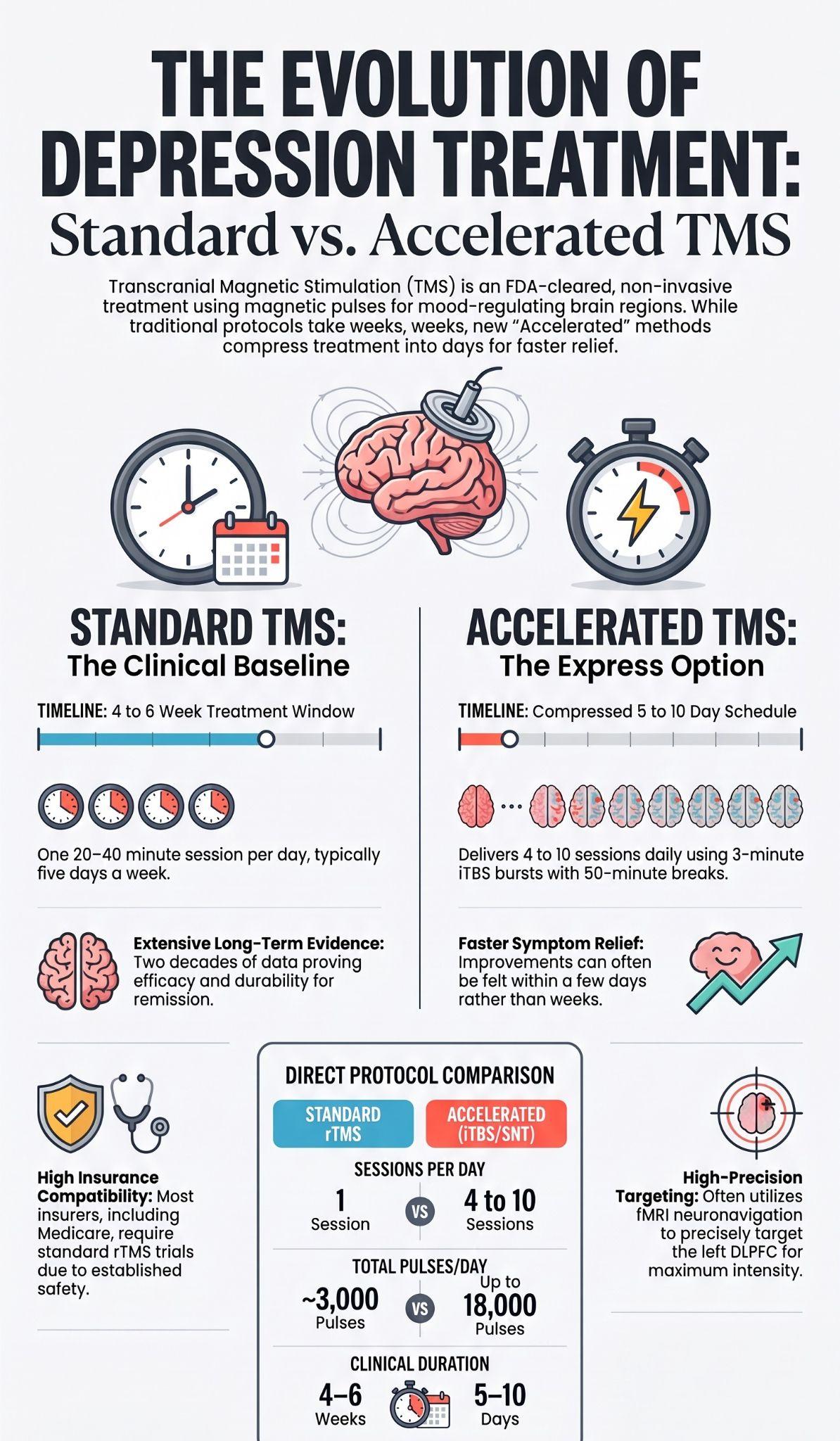
The term accelerated describes treatment given more often than standard once-daily TMS. Understanding what is accelerated TMS helps explain why some protocols use several sessions each day, while others fit an entire acute course into about five days.
According to a review published in Neuropsychopharmacology (Nature),
“Accelerated TMS research remains at a very early stage in development. The few applied protocols have not been standardized and vary significantly across a set of core elements.” –Neuropsychopharmacology, 2023.
| Variable | What Can Differ |
| Sessions | 2-10 per day |
| Duration | Days to weeks |
| Stimulation | TMS or iTBS |
| Pulse dose | Total pulses vary |
| Target | Standard or individualized |
| Navigation | Conventional or functional neuronavigation |
| Assessment | End of treatment or follow-up |
For patients comparing clinics, the protocol behind a percentage matters more than the number itself. An “80% success rate” claim is meaningless without knowing the outcome definition, sample size, and measurement timeline.
Can Accelerated TMS Work as Well as Standard TMS?
Some accelerated schedules produce outcomes similar to conventional TMS. Current evidence does not show that every accelerated protocol outperforms standard treatment.
Conventional repetitive TMS uses one session per treatment day over several weeks, whereas accelerated approaches fit multiple sessions into fewer calendar days.
When evaluating standard vs. accelerated TMS, a 175-patient UCLA study comparing a 5×5 accelerated TMS schedule with conventional TMS in treatment-resistant depression found no significant difference in symptom improvement at treatment completion.
The primary benefit of accelerated TMS is faster delivery, not necessarily higher efficacy. A five-day schedule significantly reduces calendar treatment days, accommodating patients with work, caregiving, or travel constraints.
As noted in a 2024 meta-analysis published in BMC Psychiatry,
“There was no significant difference in antidepressant effectiveness between accelerated TMS and standard TMS, while depression scores at follow-up were lower than those directly after the intervention, suggesting a potential long-term maintenance effect.” –BMC Psychiatry, 2024.
| Approach | Structure | Current Interpretation |
| Conventional TMS | One session per day | Established approach |
| Accelerated 5×5 | Five sessions daily, five days | Comparable outcomes in some settings |
| Accelerated iTBS | Multiple theta-burst sessions | Growing evidence base |
| High-dose individualized TMS | Intensive, specialized targeting | Promising but protocol-specific |
TMS of Tennessee treats accelerated treatment as a specific protocol. It is not presented as a guarantee of faster or stronger antidepressant effects.
Does Accelerated Theta-Burst Stimulation Improve the Odds of Response?
Recent evidence supports accelerated TMS therapy using intermittent theta-burst stimulation (iTBS) as an effective option for major depressive episodes compared with sham treatment.
A meta-analysis of 15 randomized controlled trials with 704 adults with major depressive episodes found accelerated iTBS was linked to nearly twice the likelihood of response compared with sham.
The reported risk ratio was 1.99, with a number needed to treat of 5. For remission, the risk ratio was 1.77 and the number needed to treat was 10. Links were also identified between treatment settings and outcomes, including total pulse exposure and time between sessions.
These results support accelerated iTBS, but they need careful reading. A risk ratio compares groups. It does not mean that nearly all treated patients respond.
Intermittent theta-burst stimulation works differently from conventional high-frequency TMS. It delivers patterned bursts of magnetic stimulation to influence brain activity in shorter treatment times.
The useful clinical question is which accelerated protocol has evidence for a specific patient group and how outcomes were measured in that research.
Why Do Some Accelerated TMS Studies Report 80% or Higher?
Very high success rates in accelerated TMS usually come from small, specialized studies. These figures should not be used as general clinical expectations.
The broad review of 23 studies and 882 participants found wide variation in response and remission outcomes. Some individual studies reported rates above 80%. One small specialized study reported a remission rate of about 90.5%.
These figures have drawn attention to Stanford Neuromodulation Therapy (SNT), previously called the SAINT protocol. SNT uses intensive treatment, personalized targeting, and a high total pulse dose. Its research has focused on treatment-resistant depression, not general depression populations.
Small studies produce large percentages because each patient makes up a bigger share of the sample. A shift in outcome for just a few participants can change the reported rate significantly.
Any headline percentage should come with four key details:
- Number of participants
- How success was defined
- The exact accelerated protocol used
- When outcomes were measured
Patients enrolled in specialized research programs often differ substantially from those seen in standard clinical settings, which makes direct comparisons unreliable.
When Should Patients Expect to Notice Results?
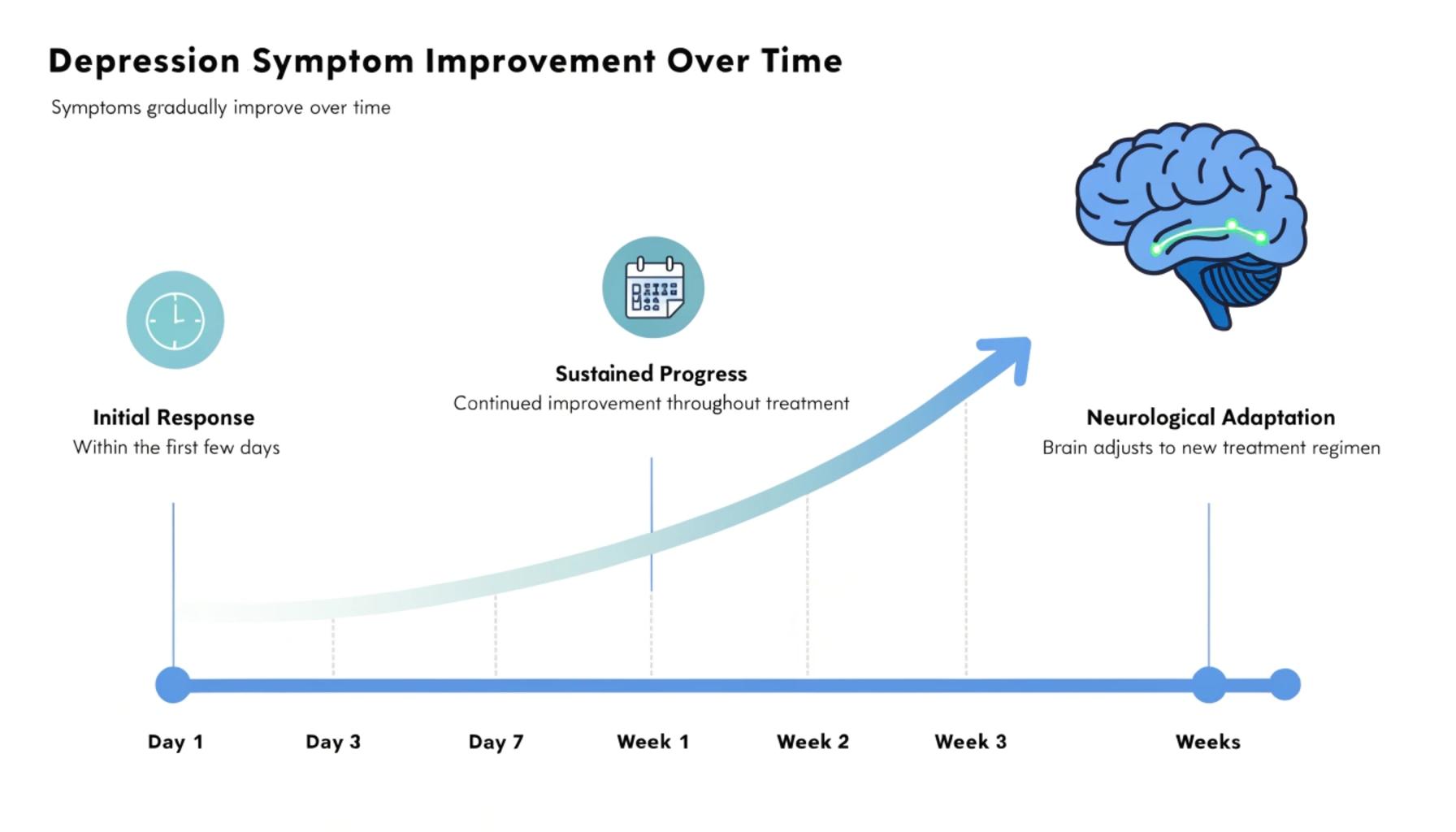
Accelerated TMS can produce improvement during treatment. However, symptom changes may continue after the last session. Scores at the end of treatment do not always reflect the final outcome.
This is especially relevant for accelerated TMS and accelerated iTBS. The treatment course may end in a few days, but the effects of repeated stimulation can keep developing during follow-up.
In a 175-patient comparison of accelerated 5×5 treatment and conventional TMS, some patients who showed little improvement at treatment end improved weeks later during follow-up.
Validated tools like the PHQ-9, MADRS, and HDRS-17 help clinicians track these changes over time.
What Does a Typical Assessment Timeline Look Like?
- Baseline depression assessment before treatment
- Symptom checks during treatment
- An assessment near the end of treatment
- Follow-up several weeks later
- Further evaluation if symptoms return or stay significant
A patient who sees little change after the last session should not assume treatment has failed. At the same time, delayed improvement should not delay appropriate care if symptoms worsen. The clinician should set the follow-up schedule before treatment starts.
Which Factors Can Affect an Individual’s Response?

An individual’s response to accelerated TMS depends on clinical history, protocol, stimulation dose, targeting method, diagnosis, and when outcomes are measured.
Most accelerated TMS evidence is specific to major depressive disorder and treatment-resistant depression. Depression study results should not be applied to other conditions without research support.
Prior treatment history matters too. Patients who have tried several antidepressants without success may have different expectations than those starting their first depression treatment.
The protocol itself shapes outcomes. Researchers have tested different daily session counts, pulse doses, stimulation frequencies, and gaps between sessions. Accelerated iTBS and high-frequency accelerated TMS are related but not the same.
Key Variables That Affect Observed Results
- Baseline depression severity
- Number of prior antidepressant trials
- Prior response to TMS or other treatments
- Stimulation intensity and motor threshold
- Total TMS pulses delivered
- Sessions per day and time between sessions
- Targeting method
- Follow-up duration
Published data shows links between treatment settings and clinical outcomes, supporting careful planning of dose and schedule rather than treating all protocols as equal.
No single factor can predict individual response with certainty. Research identifies patterns across populations. A treating clinician decides whether those patterns apply to a specific patient.
What Should Patients Ask a Clinic About Its Accelerated TMS Success Rate?
Patients should ask how a clinic calculates its success rate before comparing it with published research.
A percentage is only useful when the clinic names the protocol, patient group, outcome measure, and follow-up period behind it. A clinic reporting 80% response and a study reporting 28% remission cannot be compared directly. They measure different things.
Questions to Ask Before Starting Treatment
- Does the percentage represent response or remission?
- Which depression scale defines the outcome?
- What exact accelerated TMS protocol is used?
- How many sessions are given each day?
- How many total pulses are delivered?
- What brain region is targeted?
- Is targeting based on standard positioning or personalized neuronavigation?
- When are outcomes measured?
- How many patients does the percentage represent?
- Do the results come from published research or the clinic’s own data?
These questions help separate a meaningful clinical statistic from a marketing claim.
A clinic should also confirm whether the device is FDA-cleared for the condition being treated. FDA clearance covers specific uses. It does not apply equally to every protocol, diagnosis, or treatment schedule.
How Can TMS of Tennessee Help Patients Evaluate Their Options?

TMS of Tennessee gives eligible patients a chance to discuss noninvasive TMS treatment for depression and decide whether it fits their treatment history.
NeuroStar is FDA-cleared for major depressive disorder, obsessive-compulsive disorder, and anxious depression. It is delivered in an office setting without sedation or anesthesia. NeuroStar’s published clinical data reports 83% response and 62% remission for treatment-resistant depression. These figures come from their specific clinical population and are not a general accelerated TMS benchmark.
TMS may work alongside other treatments when clinically appropriate. It is generally considered after standard treatments have not worked well enough rather than as a first option for mild depression.
Who May Not Be Eligible for NeuroStar TMS?
Patients with certain non-removable metal near the head, specific brain implants, cochlear implants, or certain neurological risk factors may not qualify.
What Treatment Discussions at TMS of Tennessee Cover
- Whether TMS is clinically appropriate
- Which condition is being treated
- Prior antidepressant treatment history
- Expected treatment schedule
- Possible side effects including scalp discomfort or headache
- Insurance and financing options
- How symptoms will be tracked
- Follow-up plan after treatment
Key Considerations for Accelerated TMS Outcomes
Accelerated TMS offers encouraging outcomes for depression, but success rates vary based on the specific protocol used. Research across multiple studies demonstrates meaningful response and remission rates, while specialized protocols show higher rates in select patient groups. Ultimately, protocol selection determines expected outcomes.
For eligible people with treatment-resistant depression, accelerated TMS may offer a shorter treatment timeline without relying on medication.
TMS of Tennessee can help you understand whether TMS is appropriate for your situation through a professional evaluation. If you’re ready to explore your options, Schedule a TMS of Tennessee consultation and take the next step toward finding out whether this treatment fits your needs.
FAQ
How long does it take for accelerated TMS to work?
Accelerated TMS can produce symptom changes during treatment, but improvement may continue after the last session. Some patients show little change at treatment end and improve during follow-up.
The treating clinician should set a measurement schedule before treatment begins to tell the difference between a delayed response and an inadequate one.
How many sessions does accelerated TMS require?
Accelerated TMS protocols differ. Some deliver 2 to 10 sessions per day over several days. Others use a 5×5 schedule of five sessions daily for five days.
Total pulses, time between sessions, and treatment length vary by protocol. Patients should review these details with their clinician before starting.
Is accelerated TMS covered by insurance?
Coverage depends on the protocol, device, diagnosis, and payer. FDA-cleared TMS for major depressive disorder has broader coverage in some plans, but accelerated schedules may be reviewed differently. Patients should check with their insurance provider and confirm whether the specific protocol is covered.
What is the difference between accelerated TMS and the SAINT protocol?
The SAINT protocol, now called Stanford Neuromodulation Therapy (SNT), uses high-dose iTBS, personalized functional neuronavigation, and intensive daily sessions. It differs from standard accelerated TMS in targeting method and total pulse dose.
SNT research has focused on treatment-resistant depression with small, specialized groups. Its reported outcomes are distinct from broader accelerated TMS data.
Can accelerated TMS treat anxiety alongside depression?
Most accelerated TMS evidence covers major depressive disorder and treatment-resistant depression. Some FDA-cleared protocols address anxious depression. Treatment-resistant anxiety alone has less supporting evidence. Patients with both anxiety and depression should ask which condition the protocol targets and whether the device carries FDA clearance for that use.
References
- https://www.ncbi.nlm.nih.gov/pmc/articles/PMC10851556/
- https://www.nature.com/articles/s41386-023-01599-z