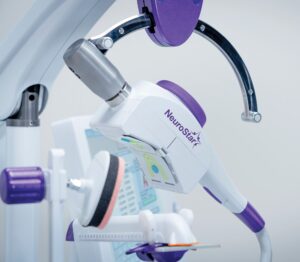
Most major U.S. health insurance providers, including UnitedHealthcare, Blue Cross Blue Shield, Cigna, Aetna, and Medicare, may cover transcranial magnetic stimulation (TMS) therapy for patients with treatment-resistant depression when medical necessity criteria are met.
Coverage often requires prior authorization, along with documentation showing unsuccessful response to antidepressant medications, psychotherapy, or both. TMS is an FDA-cleared, noninvasive treatment that uses magnetic pulses to stimulate areas of the brain involved in mood regulation without the systemic side effects linked to medication.
Because insurance requirements can differ by plan and diagnosis history, understanding the approval process can help patients avoid delays and unexpected costs. Keep reading to learn how coverage decisions are made.
Key Takeaways
- Most major U.S. health insurance providers cover TMS Therapy for major depressive disorder after failed antidepressant medication trials.
- Prior authorization, psychiatric evaluation, PHQ-9 scores, and treatment history strongly influence insurance coverage decisions.
- NeuroStar Advanced TMS Therapy offers an FDA-cleared outpatient treatment option for major depression, anxious depression, and Obsessive-Compulsive Disorder.
Quick Coverage Snapshot: Which Insurance Companies Usually Cover TMS?
Most commercial insurance plans and government programs now provide partial or full coverage for TMS therapy when medical necessity is clearly documented.
Approval does not always mean treatment is free. Deductibles, coinsurance, copays, and provider networks still affect what patients pay.
Medicare often covers around 80% of approved TMS treatment costs after deductibles are met.
| Insurance Provider | Typical Coverage Status | Common Requirements |
| Aetna | Frequently covered | Prior authorization and failed medication trials |
| Anthem | Frequently covered | Psychiatric evaluation |
| Blue Cross Blue Shield | Widely covered | Rules vary by state and plan |
| Cigna | Commonly covered | OCD coverage varies |
| Humana | Partial to full coverage | Depends on plan type |
| Kaiser Permanente | Limited availability | Usually tied to internal networks |
| UnitedHealthcare | Frequently covered | Often familiar with NeuroStar protocols |
| Medicare | Commonly covered | About 80% reimbursement in many cases |
| TRICARE | Frequently covered | For eligible military beneficiaries |
Several factors can change final reimbursement:
- In-network clinics usually reduce out-of-pocket costs
- Medicare Advantage plans may use different approval standards
- Medicaid policies vary by state
- Insurance rules can change yearly
- Maintenance sessions may not receive full coverage
Many clinics, including TMS of Tennessee, verify insurance benefits before treatment starts. This helps patients understand expected costs early.
What Conditions Does Insurance Usually Approve TMS For?
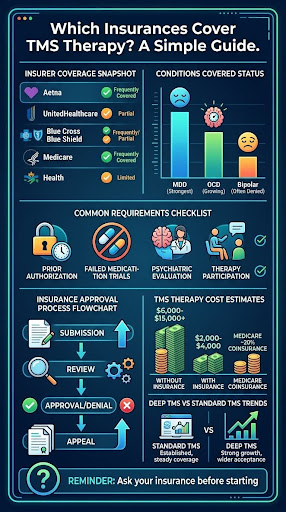
Insurance coverage is strongest for major depressive disorder and treatment-resistant depression. Coverage for OCD has increased in recent years but still depends on the insurance carrier and treatment protocol.
| Condition | Insurance Coverage Trend | Notes |
| Major Depressive Disorder | Commonly approved | Strongest insurance support |
| Treatment-Resistant Depression | Frequently approved | Usually requires failed medication trials |
| Obsessive-Compulsive Disorder (OCD) | Increasing coverage | More common with Deep TMS |
| Anxious Depression | Sometimes approved | Depends on diagnosis documentation |
| Bipolar Depression | Often denied | Frequently considered off-label |
| PTSD | Rarely approved | Limited reimbursement support |
| Smoking Addiction | Usually denied | Considered investigational by many insurers |
| Brain Injury Treatment | Rarely covered | Limited clinical approval |
Depression is the most commonly covered diagnosis
Most insurance providers recognize TMS therapy for treatment-resistant depression as an FDA-cleared treatment for adults with treatment-resistant depression.
Approval is more likely when patients have moderate to severe symptoms that did not improve with standard antidepressant medications.
Insurance companies often review depression severity scores using tools such as:
- PHQ-9
- HAM-D
- Clinical psychiatric evaluations
Providers also submit ICD-10 diagnosis codes, commonly:
- F33.1
- F33.2
Most insurers require:
- Failure of at least two antidepressants
- Participation in therapy or counseling
- A psychiatric evaluation
- Ongoing treatment monitoring
The American Psychiatric Association estimates that about 30% of people with major depression develop treatment-resistant depression.
Is OCD covered under Deep TMS?
Some insurance plans now cover Deep TMS for obsessive-compulsive disorder, though approvals remain more limited than depression treatment.
Several Blue Cross Blue Shield plans now include OCD treatment under FDA-cleared indications.
Which conditions are commonly denied?
Insurance reimbursement remains limited for many off-label uses.
Commonly denied conditions include:
- PTSD
- Migraine disorders
- Smoking addiction
- Bipolar depression
- Brain injury treatment
- Accelerated SAINT protocols
- Experimental Deep TMS combinations
Some insurers still classify accelerated Theta Burst Stimulation protocols as investigational despite ongoing research.
Why Do Insurers Require You To “Fail” Medications First?

Most insurance companies classify TMS therapy as a later-stage treatment rather than a first-line option.
This process is called step therapy, sometimes referred to as a “fail-first” policy. Patients must show that standard treatments did not provide enough improvement before insurers approve advanced brain stimulation therapies.
For many patients with chronic depression, this becomes one of the most frustrating parts of the process.
As noted by Australas Psychiatry
“While evidence supports some listed rules/conditions, others lack clinical justification and deserve to be reconsidered. These include (a) ineligibility of patients who have previously received TMS, (b) a lifetime total limit of 50 treatments (c) a second/final course being unavailable for 4 months” – Australas Psychiatry
Insurers commonly require:
- Two to four failed antidepressant trials
- Multiple medication classes, including SSRIs or SNRIs
- At least six weeks at therapeutic doses
- Cognitive behavioral therapy participation
- Ongoing psychiatric care
Providers must show that less intensive treatment approaches were unsuccessful.
Detailed records matter. Insurance reviewers often examine:
- Medication names
- Dosages
- Duration of treatment
- Side effects
- Therapy attendance
- Psychiatric notes
Incomplete documentation is one of the most common reasons approvals are delayed. TMS clinics often help organize these records before submitting authorization requests.
How Does Prior Authorization For TMS Actually Work?
Insurance approval depends heavily on medical documentation and diagnosis severity.
Before treatment begins, providers usually submit records directly to the insurance company for review.
| Required Documentation | Why Insurance Requests It |
| Medication history | Confirms failed antidepressant trials |
| Psychiatric evaluation | Verifies diagnosis severity |
| PHQ-9 or HAM-D scores | Measures depression symptoms |
| Therapy records | Shows participation in counseling |
| Letter of medical necessity | Explains why TMS is appropriate |
| Prior authorization forms | Required for insurance review |
| Treatment summaries | Provides clinical background |
| Medical billing codes | Supports reimbursement processing |
The process may take several days or several weeks depending on the insurer.
What improves approval chances?
Insurance approvals are often smoother when providers use established FDA-cleared systems such as NeuroStar Advanced TMS Therapy.
Several factors improve the likelihood of approval:
- Accurate medication records
- Documentation of side effects
- Current depression severity scores
- Confirmed treatment-resistant depression diagnosis
- In-network providers
- Ongoing psychotherapy participation
Clear documentation usually matters more than lengthy explanations.
Common reasons TMS claims get denied

Insurance denials often happen for predictable reasons.
Common denial triggers include:
- Symptoms described as moderate instead of severe
- Missing therapy documentation
- Incomplete antidepressant history
- Off-label diagnosis requests
- Out-of-network clinics
- Active substance abuse concerns
- Seizure disorder risks
Some insurers also deny requests when treatment schedules do not follow standard 30-to-36-session protocols.
Patients can often appeal denials with additional records or updated psychiatric evaluations.
How Much Does TMS Cost With Insurance?
Even with insurance coverage, many patients still pay deductibles, copays, or coinsurance during treatment, which is why understanding TMS Therapy Costs can help patients prepare financially before starting care.
A standard TMS treatment course usually includes 30 to 36 sessions over six to seven weeks. Sessions are typically scheduled five days per week.
Copays often range between $20 and $100 per session.
| Treatment Scenario | Estimated Patient Cost |
| Without insurance | $6,000 to $15,000+ |
| With commercial insurance | $2,000 to $4,000 out of pocket |
| Medicare example | About 20% coinsurance |
There are also indirect costs that patients do not always expect at the beginning of treatment, including:
- Transportation
- Parking fees
- Time away from work
- Childcare arrangements
- Daily scheduling demands
Many patients describe the routine of repeated appointments as physically and emotionally tiring, especially during the first few weeks.
Financial responsibility can also depend on:
- Annual deductibles
- Coinsurance percentages
- Session limits
- Maintenance treatment coverage
- Financing programs
NeuroStar Advanced TMS Therapy sessions usually last about 19 minutes. Most patients can return to normal activities immediately afterward because treatment does not require anesthesia or sedation.
Compared with electroconvulsive therapy (ECT), TMS is less invasive and does not involve memory loss associated with anesthesia-based treatments.
The “TMS Dip”: Why Some Patients Think Treatment Is Failing Midway
Some patients experience temporary worsening of symptoms midway through treatment, often around sessions 15 through 20.
Patients sometimes call this phase the “TMS dip.”
Common symptoms during this period include:
- Temporary fatigue
- Emotional sensitivity
- Mild headaches
- Mood fluctuations
- Discouragement
- Delayed symptom improvement
This phase can be unsettling, especially for patients expecting rapid improvement.
Most providers encourage patients to complete the full treatment course before deciding whether therapy is effective. Clinical improvement often develops gradually over several weeks.
Some patients notice changes in sleep, energy, or anxiety before mood symptoms improve.
Stopping treatment early may also create insurance problems. Certain insurers require a completely new prior authorization request if treatment is interrupted.
TMS works by delivering focused magnetic pulses to brain regions involved in mood regulation. The treatment uses technology similar to MRI systems and does not involve electrical shocks or sedation.
Deep TMS vs Standard TMS: Does Insurance Treat Them Differently?
Insurance companies often use different billing rules for Deep TMS and standard repetitive TMS (rTMS). Because there are different Types of TMS Therapy, several FDA-cleared systems are widely used in clinical practice, each with its own clinical protocol.
Several FDA-cleared systems are widely used in clinical practice.
| System | Primary Use | Insurance Familiarity | Approval Trend |
| NeuroStar Advanced TMS Therapy | Major depression, anxious depression | Very high | Frequently approved |
In a recent analysis by Medscape
“Results showed adjusted Hamilton Depression Rating Scale depression score reductions of 19.1 points in the accelerated TMS group compared to 19.8 points in the standard group. In addition, the response rate was 87.8% vs 87.5%.” – Medscape
Some insurers require separate authorization codes for Deep TMS compared with standard rTMS treatment.
NeuroStar currently carries FDA clearance for:
- Major depressive disorder
- Obsessive-compulsive disorder
- Anxious depression
TMS may not be appropriate for patients with:
- Certain metal implants
- Cochlear implants
- Increased seizure risk
- Untreated neurological conditions
Clinical studies involving treatment-resistant depression have shown meaningful response and remission rates in properly selected patients. Outcomes vary depending on diagnosis severity, treatment consistency, and medical history.
Why State Mental Health Parity Laws Do Not Always Help
Mental health parity laws were designed to improve fairness between mental health coverage and medical coverage. In practice, insurance approvals can still vary widely.
One major reason is ERISA, a federal law that regulates many employer-sponsored insurance plans. Two people with the same diagnosis may receive different coverage decisions even if they live in the same city and see similar providers.
Fully insured vs. self-funded plans
| Plan Type | Rules Followed |
| Fully insured plans | State mental health parity laws |
| Self-funded employer plans | Federal ERISA rules |
This distinction affects:
- Prior authorization standards
- Appeal rights
- Reimbursement policies
- Coverage limitations
Large employer plans often follow federal rules instead of state protections.
That is why some patients receive approvals quickly while others face repeated denials despite similar clinical histories.
What Should You Ask Your Insurance Company Before Starting TMS?
Patients should contact their insurance provider before beginning treatment.
Several questions can prevent unexpected bills or delays later.
Important questions include:
- Is prior authorization required?
- How many sessions are covered?
- Are maintenance sessions included?
- Is the clinic in-network?
- Does the plan require psychotherapy participation?
- Are there separate rules for Deep TMS?
- What deductible applies?
- What are the copay or coinsurance amounts?
- Are there restrictions related to substance use history?
Patients should also request written confirmation whenever possible. Written authorization records may help during appeals if reimbursement disputes happen later.
What Patients Should Know About TMS Insurance Coverage
Insurance approval for TMS therapy often requires more than a depression diagnosis. Most providers ask for medication history, psychiatric evaluations, therapy records, and current symptom assessments before authorizing treatment. For people already dealing with severe depression, the process can feel stressful and time-consuming.
If you are considering NeuroStar Advanced TMS Therapy, TMS of Tennessee can help verify insurance eligibility, explain treatment requirements, and guide you through the approval process. Their Franklin clinic offers personalized, non-drug treatment for major depression using targeted magnetic stimulation. Financing options are also available to help make care more accessible.
FAQ
Does Health Insurance cover TMS Therapy for treatment-resistant depression?
Many Health insurance plans cover TMS Therapy for treatment-resistant depression when patients meet medical necessity requirements. Insurance providers usually ask for records showing previous treatment attempts with antidepressant medications, therapy or counseling, and other treatment options. A psychiatric evaluation is also common before approval. Each insurance company and health insurance provider follows different rules for transcranial magnetic stimulation coverage and reimbursement.
What affects out-of-pocket costs for transcranial magnetic stimulation treatment?
Out-of-pocket costs for transcranial magnetic stimulation depend on deductibles, copays, coinsurance, and provider network status. Some insurance plans cover most treatment expenses, while others leave patients responsible for larger balances. Healthcare providers may also offer financing options, deferred interest financing, or reimbursement support. Insurance verification before treatment begins helps patients understand expected costs for Deep TMS Therapy, Theta Burst Stimulation, and related mental health services.
Why do insurance providers require prior authorization for brain stimulation treatments?
Insurance providers require prior authorization to confirm that TMS Therapy meets medical necessity guidelines. Most insurance carriers review treatment history, psychiatric evaluation records, and documentation showing unsuccessful results from antidepressant medications or Cognitive Behavioral Therapy. Some health insurance plans also review clinical protocols, diagnostic tools, and brain imaging results. These reviews help determine whether brain stimulation treatment is appropriate for major depressive disorder and related mental health conditions.
Can TMS Therapy coverage differ for other mental health conditions?
Yes, insurance coverage for TMS Therapy can vary depending on the diagnosed mental health condition. Many U.S. health insurance companies provide stronger coverage for treatment-resistant depression and major depression than for conditions like Obsessive-Compulsive Disorder, Bipolar Depression, smoking addiction, brain injury, or Substance abuse. Insurance providers may also compare TMS Therapy with other treatment options, including Electroconvulsive Therapy, therapy or counseling, and medication-based treatment courses before approving coverage.
What should patients prepare before starting the insurance reimbursement process?
Patients should prepare medical records, psychiatric evaluation results, treatment history, and documentation of previous antidepressant medications before starting the insurance reimbursement process. Healthcare providers, insurance specialists, and care coordinators often help patients complete insurance verification and medical coding requirements. Keeping organized records of clinical protocols, diagnostic tools, and medical necessity documentation can improve coverage options and reduce delays during the financing process or reimbursement review.
References
- https://pubmed.ncbi.nlm.nih.gov/37128938/